Can AI Understand Sewing Pattern Instructions? I put it to the test.
Using Adobe Acrobat AI Assistant With
PDF Sewing Pattern Instructions
Artificial intelligence has made its way into our PDFs. Adobe Acrobat AI Assistant can search a PDF sewing pattern instruction booklet and answer questions about what's inside. When I first discovered the feature, I was intrigued. As a sewing pattern designer, I could immediately see how something like this might help a sewist find a seam allowance, finished measurement, or construction step without searching through an entire booklet.
So, I decided to test it using an instruction booklet I know very well: my own.
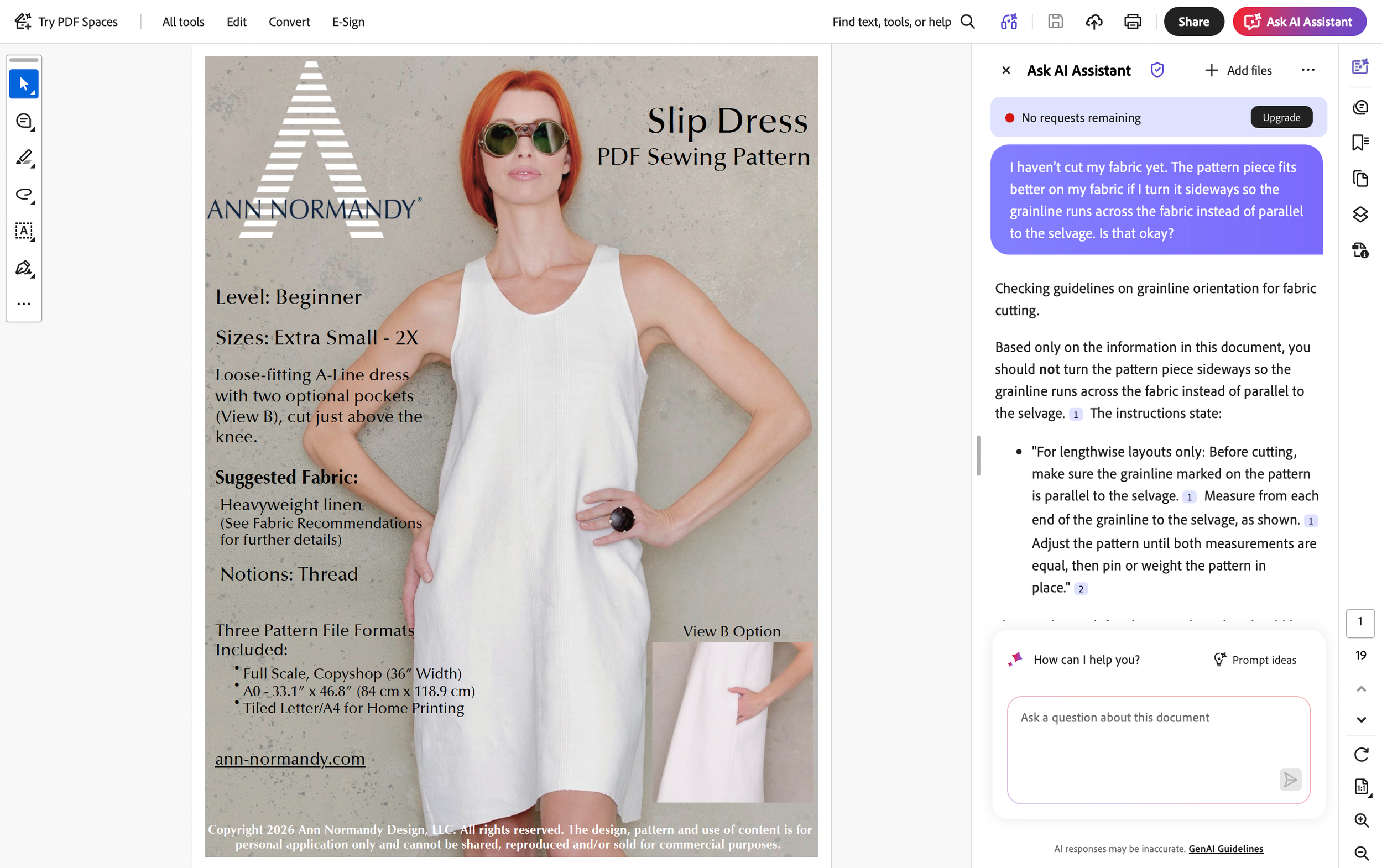
Adobe Acrobat AI Assistant answering a sewing question using the Ann Normandy Design Slip Dress PDF sewing pattern instructions.
I uploaded the instruction booklet for my Slip Dress and began asking the kinds of questions I could imagine a sewist asking while working through a pattern. Some of the answers were surprisingly good. Others gave me reason to be much more cautious about how I would recommend using AI with sewing pattern instructions.
After spending quite a bit of time testing it, I've concluded that AI Assistant can be a useful search tool for a PDF sewing pattern. I would be much more hesitant to use it for anything more.
Where I Think AI Can Be Helpful
One of the most practical uses I found was locating information.
What's the seam allowance?
Where are the finished garment measurements?
When are the pockets constructed?
Where does the booklet discuss staystitching?
Those questions have answers already in the PDF. Instead of flipping through pages or searching manually, AI Assistant can often locate that information quickly.
During my testing, it correctly found the ¾” seam allowance in my instructions, even when I deliberately asked where the booklet specified a 5/8” seam allowance. It found the correct information.
It also found information on staystitching and pocket construction. Those results impressed me and are where I see the tool's greatest value.
But then I started asking questions that required more interpretation.
That's Where I Became More Cautious
One of my tests involved garment length. I asked how someone who is 5 feet 10 inches tall should adjust the length of the dress. The AI Assistant gave me a very plausible answer about a standard drafting height and how much length to add.
The problem was that I never put that information in my instruction booklet.
The AI wasn't finding my answer anymore. It was creating an answer based on information from somewhere else.
I changed my prompt and specifically told it to answer using only information contained in my instruction booklet, without adding outside sewing advice or making assumptions. That helped. When I asked the height question again, it correctly said my instructions didn't provide a specific height adjustment.
But that protection didn't always work.
The Answer That Raised a Flag
My Slip Dress instructions specifically accommodate both lengthwise and crosswise cutting layouts. For a lengthwise layout, the marked grainline is positioned parallel to the selvage. For a crosswise layout, the bottom edge of the pattern is aligned with the selvage.
I asked AI Assistant whether I could turn the pattern sideways, so the grainline ran across the fabric instead of parallel to the selvage. It told me no; that answer directly contradicted my instructions and my fabric layout graphic.
I then asked it to check the entire document and answer again. It confidently gave me the wrong answer a second time.
That test changed how I would recommend this tool to my clients. The information wasn't missing. It was right there in the booklet, in two different places, and AI Assistant still interpreted it incorrectly.
“Adobe Acrobat AI Assistant was surprisingly helpful.
It was also confidentally wrong”
A Plausible Answer Can Still Cost You Fabric
This is where to remember what's at stake when we're sewing.
We all know that when you purchase a sewing pattern, it's only part of your investment. You're also purchasing fabric, thread, interfacing, and perhaps buttons, zippers, or other notions. Good fabric can be very expensive, and once you've cut it, there's no undo button.
That's one reason I have always encouraged my customers not to experiment with an unfamiliar construction technique for the first time on their good fabric.
If you don't understand a step, take a piece of scrap fabric and make a small muslin of that area first. Sew the pocket opening. Practice the neckline finish. Try the technique until you understand what the instructions are asking you to do. Taking the time to practice and understand a technique is part of what makes a garment well made.
A few minutes with scrap fabric can be much less expensive than discovering a misunderstanding after you've cut into beautiful linen.
I would apply that same caution to some advice generated by AI.
Use AI Assistant More Like a Search Bar
After my testing, this is the simplest way I can describe my own comfort level with it.
I would use AI Assistant to help me find information in the instruction booklet.
I would not automatically trust it to tell me what alteration to make, which size to choose, how to correct a fitting problem, whether I should change the construction method, or what the designer meant when the written instructions aren't clear.
Those are very different questions.
If AI tells you the seam allowance is ¾”, go to the cited section and confirm it.
If it tells you to lower an armhole, blend between sizes, change the grainline, substitute a fabric, or alter a construction method, I would stop before doing anything irreversible.
A Few Prompts That Worked Better
How you phrase your question matters. During my testing, I found better results when I specifically told AI Assistant to stay within the information in my instruction booklet. It still wasn't foolproof, as my crosswise layout test proved, but these are the kinds of prompts I would recommend:
Find a specific answer: “According to this instruction booklet, what is the seam allowance? Show me where you found the answer.”
Locating instructions: “Find the instructions for constructing the pockets and take me to that section of the PDF.”
Keep AI from adding its own sewing advice: “Answer using only information contained in this instruction booklet. Do not add outside sewing advice or make assumptions. If the answer isn't in the booklet, tell me that.”
To double-check an answer: “Show me the exact wording in this instruction booklet that supports your answer.”
I especially like that last question. If AI can't show you where an answer came from, that's a good reason to stop before acting on it. And even when it can point you to the source, read the original instruction yourself. As my testing showed, AI can find the right section of a document and still interpret it incorrectly.
The sewing pattern instructions are the authority. If the answer still isn't clear, another resource is much more valuable.
Ask the Pattern Designer
When a client purchases one of my patterns, I don't consider my job finished when the PDF is downloaded. I encourage my customers to contact me with questions and comments. I'm here to help and listen to your comments.
I do value those conversations. If you don't understand something I've written, I would rather you ask me than struggle through it or risk ruining your fabric.
Your questions also help me become a better pattern designer. If someone has difficulty understanding an instruction, I want to know. I can explain it differently. Maybe adding an illustration might make it clearer, or the instructions should include additional information.
That connection between a sewist and an independent pattern designer is something I would not want technology to replace.
AI can search my instructions. It can't tell you what I intended better than I can.
My Three Suggestions Before You Cut into your fabric
If you decide to experiment with AI Assistant or another AI tool with your PDF sewing patterns, my recommendation is simple:
1. Find it. Use AI to help locate the information in the instruction booklet.
2. Check it. Go back to the actual instructions and confirm the answer yourself. If you're unsure about a construction technique, test it first with scrap fabric or a small muslin.
3. Ask the designer. If something still isn't clear, especially before cutting or altering your pattern, contact the pattern designer.
For my Ann Normandy Design customers, that last step is easy: email me at kcollins@ann-normandy.com. Questions and comments are always welcome.
So, Can AI Understand Sewing Pattern Instructions?
In my testing, Adobe Acrobat AI Assistant was surprisingly helpful. It was also confidently wrong.
It successfully found seam allowances, construction information, and definitions in my PDF sewing pattern instruction booklet. At other times, it supplied information I had never written or confidently misunderstood an instruction that was clearly in the document.
For me, that is enough to draw a clear line between using AI to find information and trusting AI to make sewing decisions.
I'm comfortable using it more like a very fast search bar. I'm much less comfortable letting it interpret fit, recommend alterations, make construction decisions, or tell a sewist what a designer intended when the answer is unclear.
And when there is a question about one of my patterns, I would much rather you ask me.
Find it. Check it. Ask the designer. And when you're trying something new, test it on scrap fabric before you cut into the good stuff.
Happy Sewing!
Kim
Looking for More Sewing Help?
Visit my Sewing Tutorials for step-by-step techniques and additional sewing guidance to help you through your next project.